Itching, thicker discharge, or burning while you're expecting can send you searching "yeast infection for pregnant woman" late at night. Pregnancy hormones shift the vaginal environment, some familiar remedies aren't appropriate, and a few symptoms overlap with conditions that need a clinician's eye. This guide covers the signs, what's normal, and which next steps are considered safe. In short, a yeast infection for pregnant woman readers is common and usually manageable. It is always worth a call to your OB or midwife before you try anything.
TL;DR
A yeast infection for pregnant woman readers is common and usually manageable, but your OB or midwife should decide on treatment.
Higher estrogen and glycogen-rich vaginal tissue during pregnancy can favor Candida overgrowth.
Normal pregnancy discharge (leukorrhea) is thin, milky and mild-smelling. Yeast discharge tends to be thick, white and clumpy, with itching or burning.
Treatment during pregnancy is your clinician's decision. Do not start any antifungal, boric acid or supplement on your own.
Pooled trial data in non-pregnant women show probiotics work, at best, as a short-term add-on to antifungals, not a replacement 13.
Any supplement with wormwood or black walnut hull is off the table while pregnant, nursing or trying to conceive.
Why Are Yeast Infections So Common During Pregnancy?
Pregnancy reshapes the vaginal environment that normally keeps Candida in check. In a healthy vagina, lactobacilli produce lactic acid, which keeps the vagina acidic and has antimicrobial properties 7. Pregnancy shifts several conditions around that protective system at once. Rising estrogen thickens the vaginal lining and loads its cells with glycogen, a stored sugar. Glycogen feeds lactobacilli, but it also gives Candida, which already lives harmlessly in many women, more fuel. Immune changes during pregnancy make the body slower to rein in an overgrowth, so symptoms that stay quiet at other times can surface.
Candida itself is adaptable. In lab studies, Candida albicans can switch into an invasive hyphal form and build protective biofilm, traits researchers examine when asking why overgrowth persists 4. For trimester-specific context, read our guide to probiotics in the third trimester.
The Lactobacillus Ecosystem and Candida
Candida albicans usually lives in the vagina in small numbers, held back by an acidic, lactobacillus-led ecosystem. In lab tests on Candida isolated from women, carvacrol lowered the expression of enzymes the yeast uses to invade tissue 9. Lab work also shows that carvacrol and thymol reduced mature Candida biofilms in culture 11. Biofilms help explain why symptoms can linger or return, and why a clinician should guide treatment.
What Does Pregnancy Discharge Look Like Compared With Yeast?
Normal pregnancy discharge and yeast can look similar at first glance. Healthy pregnancy discharge, called leukorrhea, increases as hormones rise and reflects the acidic, lactobacillus-dominated setting described in microbiome reviews 7. It is thin to slightly milky, white or clear, with a mild smell or none. It may feel heavier than usual, but it should not itch or burn. Yeast discharge is typically thick, white and clumpy, often compared to cottage cheese, with little odor. The bigger clue is what comes with it: itching, redness, vulvar swelling, and burning during urination or sex.
A quick comparison:
Normal discharge: thin, milky or clear, mild smell, no itching
Yeast: thick, clumpy, white, itchy or burning
Other causes: grey or fishy-smelling discharge, or watery fluid, needs prompt evaluation
Because symptoms overlap, call your prenatal clinician before trying any remedy.
How Do OBs Usually Handle Yeast Infection Treatment in Pregnancy?
When a clinician confirms a yeast infection during pregnancy, treatment usually starts with a topical azole cream or vaginal suppository, often for a longer course than outside pregnancy. Topical clotrimazole is a familiar option; it served as the starting treatment in a retrospective study in which a vaginal L. plantarum capsule was given afterward 3. Oral antifungal pills are generally avoided in pregnancy unless your OB decides otherwise. Boric acid comes up often online, but it is not a pregnancy option. A 2011 review covering 14 reports of vaginal boric acid described yeast clearance in 40% to 100% of cases, with none showing fewer recurrences 6.
That boric acid work did not involve pregnant patients. If you want the full picture outside pregnancy, see our explainer on boric acid suppositories.
| Option | Typical role in pregnancy | Key caution |
|---|---|---|
| Topical azole cream or suppository | Usual first choice when prescribed | Longer course often needed |
| Oral antifungal pills | Generally avoided | Only if your OB decides |
| Boric acid (vaginal) | Not a pregnancy option | Avoid unless your OB directs it |
| Probiotics | Add-on idea, unstudied in pregnancy | Ask your OB first |
| Wormwood or black walnut supplements | Not appropriate | Not for pregnancy, nursing or TTC |
What Does Probiotic Research Say About Yeast and Vaginal Flora?
Probiotic evidence here is limited, because the main trials enrolled women who were not pregnant. A 2026 meta-analysis pooling 14 trials found that probiotics added to antifungal treatment improved short-term yeast infection cure, with no long-term benefit, and probiotics alone did worse than antifungals long term 13. That pattern frames probiotics as an add-on to antifungal care, never a replacement. An earlier Cochrane review of 10 trials in non-pregnant women likewise showed only a modest short-term gain from adding probiotics to antifungal drugs, with no lasting difference 14. A systematic review of 34 studies of products used vaginally found promise for BV but little for yeast, and dosed strains did not persist long after dosing stopped 8.
Oral blends have smaller evidence bases. In a small study of 36 asymptomatic women with no control group, 6 weeks of an oral L. acidophilus, L. rhamnosus and L. reuteri blend moved 6 of 10 women with dysbiosis to a normal Nugent score 2. In 64 healthy non-pregnant women, oral L. rhamnosus GR-1 with L. reuteri RC-14 for 60 days shifted asymptomatic BV-type flora to normal in 37% vs 13% on placebo 1. None of this research tested pregnancy. To understand delivery formats, compare them in our guide to oral vs vaginal probiotics.
Which Ingredients Are Studied for Yeast Balance in the Lab?
A few ingredients have been studied for yeast balance, almost entirely outside pregnancy. Caprylic acid was described as a treatment for vaginal yeast infection in women with monilial vaginitis in a 1953 report, but that era's methods are not equivalent to current products, and symptoms still require clinician care 12. Modern caprylic acid work is mostly laboratory research: in lab studies, caprylic acid blocked Candida albicans from switching to its invasive hyphal form and from forming biofilm 4. Oregano's compounds have been studied the same way; in lab cultures, thymol and carvacrol induced oxidative stress in Candida albicans 10.
In lab tests, caprylic acid combined with carvacrol or thymol (compounds found in oregano) killed Candida albicans far faster than either alone 5. These are dish experiments, not evidence in women, and none of these ingredients has been studied in pregnancy. That gap is exactly why pregnancy decisions belong with your obstetric team. Caprylic acid is a medium-chain fatty acid whose membrane-active chemistry is the main reason researchers keep testing it against Candida, and oregano leaf is valued for its carvacrol and thymol content. None of this is a pregnancy plan.
Which Lactobacillus Species Does Vaginal Flora Research Focus On?
Vaginal flora research centers on lactobacilli. Reviews of vaginal lactobacilli describe lactic acid production as the core of a healthy, acidic environment 7. Lab work adds species-level detail, for example that L. reuteri makes reuterin, a natural antimicrobial compound first isolated in 1988 15. L. acidophilus, L. rhamnosus, L. reuteri and L. plantarum are among the lactobacillus species most discussed in vaginal flora research. While you are expecting, the right move is simple: work with your OB or midwife on a pregnancy-appropriate topical plan.
Summary: What Matters Most for a Yeast Infection During Pregnancy?
Topical treatment chosen by your OB remains the standard path, and probiotics have only shown short-term add-on value in non-pregnant women 13. A yeast infection for pregnant woman readers is usually uncomfortable rather than dangerous. Learn the difference between normal leukorrhea and thick, itchy yeast discharge, and get any grey, fishy or watery discharge checked promptly. Skip boric acid and self-started supplements while pregnant. For more context, read our probiotics third trimester guide.
FAQ
Q: Is it safe to treat a yeast infection while pregnant?
A: Yes, with your prenatal provider guiding it. Topical antifungal creams or vaginal suppositories are generally preferred during pregnancy, while oral antifungal pills are usually avoided. Confirm the diagnosis first, because bacterial vaginosis and other infections cause similar symptoms but need different treatment. Finish the full prescribed course even if symptoms ease early.
Q: What is the safest first step for a yeast infection for pregnant woman readers?
A: Call your OB or midwife before using anything, including over-the-counter creams. They can confirm it is yeast rather than BV or another infection, choose a pregnancy-appropriate topical treatment, and set the course length. Avoid boric acid, oral antifungals, and new supplements unless your clinician specifically recommends them.
Q: What does normal pregnancy discharge look like versus a yeast infection?
A: Leukorrhea is usually thin, milky or clear, mild-smelling, and comfortable. Yeast tends to produce thick, white, clumpy discharge with itching, burning, redness, or soreness. A fishy odor or gray, green, or yellow discharge suggests a different problem, so contact your provider rather than guessing and self-treating at home.
Q: Can a yeast infection harm the baby?
A: Usually not. A vaginal yeast infection is uncomfortable but is generally not considered dangerous to the developing baby. An infection still active at delivery can pass to the newborn as oral thrush, which is why prompt diagnosis and finishing treatment before your due date matter. Mention any symptoms at prenatal visits.
Q: Why do I keep getting yeast infections during pregnancy?
A: Higher estrogen increases glycogen in vaginal tissue, which can feed yeast. Immune changes, blood sugar shifts, recent antibiotics, and non-breathable clothing may also contribute. If infections keep returning, ask your provider about gestational diabetes screening and about confirming with testing that the cause is actually yeast and not something else.
Q: Can probiotics replace antifungal treatment during pregnancy?
A: No. Research in non-pregnant women shows probiotics help, at most, as a short-term add-on to antifungal medicine, and pregnant women were not included in those studies. Probiotics do not clear an active infection on their own. Talk with your prenatal provider before starting any probiotic or supplement while pregnant.
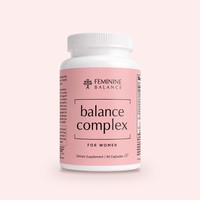
Not for use if pregnant, nursing, or trying to conceive: Balance Complex contains wormwood and black walnut hull.
References
- Reid et al., 2003. PMID: 12628548
- Ansari et al., 2023. PMID: 37111086
- De Seta et al., 2014. PMID: 25305660
- Jadhav et al., 2017. PMID: 28922057
- Bae et al., 2019. PMID: 31334617
- Iavazzo et al., 2011. PMID: 21774671
- Tachedjian et al., 2017. PMID: 28435139
- van de Wijgert J, 2020. PMID: 31299136
- Hosseini et al., 2016. PMID: 28491252
- Khan et al., 2015. PMID: 25681060
- Miranda-Cadena K et al., 2021. PMID: 34649348
- Reich WJ et al., 1953. PMID: 13016687
- Chen et al., 2026. PMID: 41547378
- Xie et al., 2017. PMID: 29168557
- Talarico et al., 1988. PMID: 3245697